Cold Email Subject Lines: What Gets Opened in 2026 (35 Examples)

Founder and CEO of Ozigi. Writes about go-to-market, content strategy, and the tooling small teams rely on.
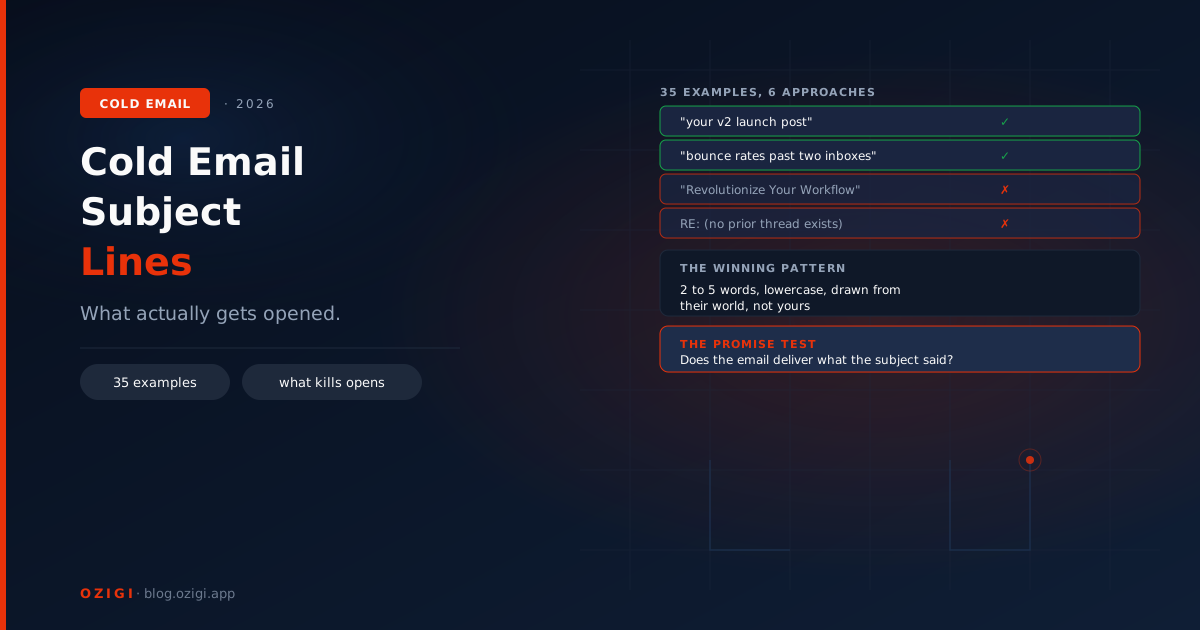
TL;DR: A cold email subject line has one job: earn the open honestly. The winning pattern is 2 to 5 specific words, lowercase reading as human, drawn from the recipient's world: their project, their problem, their trigger event. "your v2 launch post" beats "Quick question" beats "Revolutionize Your Workflow" by widening margins. Avoid the spam-filter tells (all caps, RE: fakery, urgency words, emoji stacks) and the trust-killers (bait-and-switch, fake replies). 35 examples below, sorted by the approach behind them, plus the one test every subject must pass: does the email deliver what the subject promised?
The subject line gets three seconds and about 40 characters of phone screen to earn the open. Most advice responds to that pressure with cleverness, curiosity gaps, power words, personalization tokens, and cleverness is exactly what a decade of cold email has trained recipients to distrust.
What still works is narrower and more honest: specificity. A subject drawn from the recipient's actual world cannot be pattern-matched to spam, because spam cannot know their world. Every example below applies that one idea a different way.
What Makes a Cold Email Subject Line Work?
Three properties: it is specific to the recipient, it is honest about the email behind it, and it reads like a person typed it. The third one is why lowercase, fragmentary subjects ("your migration post") consistently outperform Title Case Announcements: internal email between colleagues looks like the former, and marketing looks like the latter. The subject's register signals which pile you belong in before a word of your email is read.
The honesty property is the one with teeth. A subject that overpromises gets the open and then pays for it: the mismatch between subject and body is what recipients report as spam, and complaint rate is the metric that gets sending domains flagged.
The Trigger Subjects
Built on something they did. The strongest category, because it proves research in four words.
- your [project] launch
- the [topic] post
- saw the [company] news
- congrats on [milestone], one thought
- your comment on [thread]
- [their talk title], question
- the hiring post for [role]
The Problem Subjects
Built on the pain your product solves, named in their vocabulary.
- [problem] at [company]?
- bounce rates past two inboxes
- [metric] slipping?
- the [tool they use] ceiling
- when [process] breaks at [their stage]
- [competitor of theirs] is doing this differently
The Mutual and Context Subjects
Built on something you share. Real mutuals only, the fabricated version costs more than it earns.
- [mutual name] pointed me your way
- [shared community] + quick q
- fellow [conference] attendee
- we both know [person/company]
- from the [community] thread
The Question Subjects
Built on a question the email genuinely answers.
- worth 15 minutes?
- right person for [area]?
- how are you handling [problem]?
- is [assumption about their setup] still true?
- open to a two-minute example?
The Plain Subjects
Built on stating what the email is. Boring, honest, and quietly effective, especially in follow-up position.
- idea for [company]
- [your company] x [their company]
- [number] for [company], e.g. "23% for Datafold"
- re: your onboarding flow (only if the email is genuinely about it)
- one thing I'd change about [their public asset]
- [their role] at [their stage]
- quick one about [specific thing]
The Follow-Up Subjects
Mostly: none. Follow-ups belong in the same thread with the original subject. When a fresh thread is genuinely warranted:
- one more data point on [problem]
- the [resource] I mentioned
- closing the loop on [topic]
- [original subject], shorter version
- should I close this out?
What Kills Cold Email Subject Lines?
Two failure families. The filter tells get you buried before a human looks: ALL CAPS, urgency vocabulary (act now, limited time, last chance), currency symbols and percentages stacked with exclamation marks, emoji clusters, and "FREE" doing its best 2009 impression.
The trust tells are worse, because a human sees them: the fake "RE:" on a thread that never existed, the fake "FWD:", the bait subject with no relationship to the body, and the personalization token wearing its brackets, "quick question {{first_name}}", which happens at volume more than anyone admits. Each of these can win an open and loses everything after it, because the reader now knows the sender lies in small ways.
There is a subtler version of the same mistake: the subject that is technically true but tonally false, a chummy "hey, quick thing" on a formal pitch. Subject and body are one register decision, the same one covered across the templates and the tone guide.
How Do You Test Subject Lines?
Hold everything else still and change only the subject, 50 sends per variant minimum before reading anything into the numbers, and judge on replies, not opens. A subject that wins opens and loses replies is optimizing the wrong end of the funnel; the open is only worth what the email converts it into.
And before any A/B mechanics, every candidate passes the promise test: read the subject, then the email, and ask whether the email is what a reasonable person expected. If not, the subject is a small lie, and small lies compound at volume. Generating subject-body pairs that keep the promise by construction is part of what the free cold email generator does, the subject is drawn from the same recipient signal as the opener, so the two cannot drift apart. No signup required.
Frequently Asked Questions
What is a good subject line for a cold email? Two to five specific words from the recipient's world: their project ("your v2 launch"), their problem ("bounce rates past two inboxes"), or a real shared context ("[name] pointed me your way"). Specificity beats cleverness because it cannot be pattern-matched to spam.
Should cold email subject lines be lowercase? Lowercase or sentence case, yes. Internal email between colleagues looks like that, and marketing looks like Title Case With Every Word Capitalized. The subject's register decides which mental pile you land in before the email is read.
How long should a cold email subject line be? Two to five words, under about 40 characters, which is what a phone inbox shows. Front-load the specific word, "[their project], question" survives truncation; "A question I wanted to ask about..." does not.
Do "RE:" and "FWD:" subject lines work for cold email? They win opens and lose everything else. The recipient discovers there was no prior thread, files you as a sender who lies in small ways, and reports accordingly. Complaint rate damages the whole domain, so the trick costs far more than the open was worth.
Why are my cold emails not getting opened? In diagnosis order: deliverability first (a flagged domain means subjects never get seen), list quality second, subject specificity last. A generic subject on a healthy domain still gets some opens; a perfect subject in the spam folder gets none. The full diagnosis path is in why am I getting no replies.
Ozigi drafts the subject and the email from the same recipient signal, so the promise holds. Try the free cold email generator, no signup required.
About the author
Founder and CEO of Ozigi. Writes about go-to-market, content strategy, and the tooling small teams rely on.