Conversational Cold Email Examples: 5 Rewrites From Corporate to Human

Founder and CEO of Ozigi. Writes about go-to-market, content strategy, and the tooling small teams rely on.
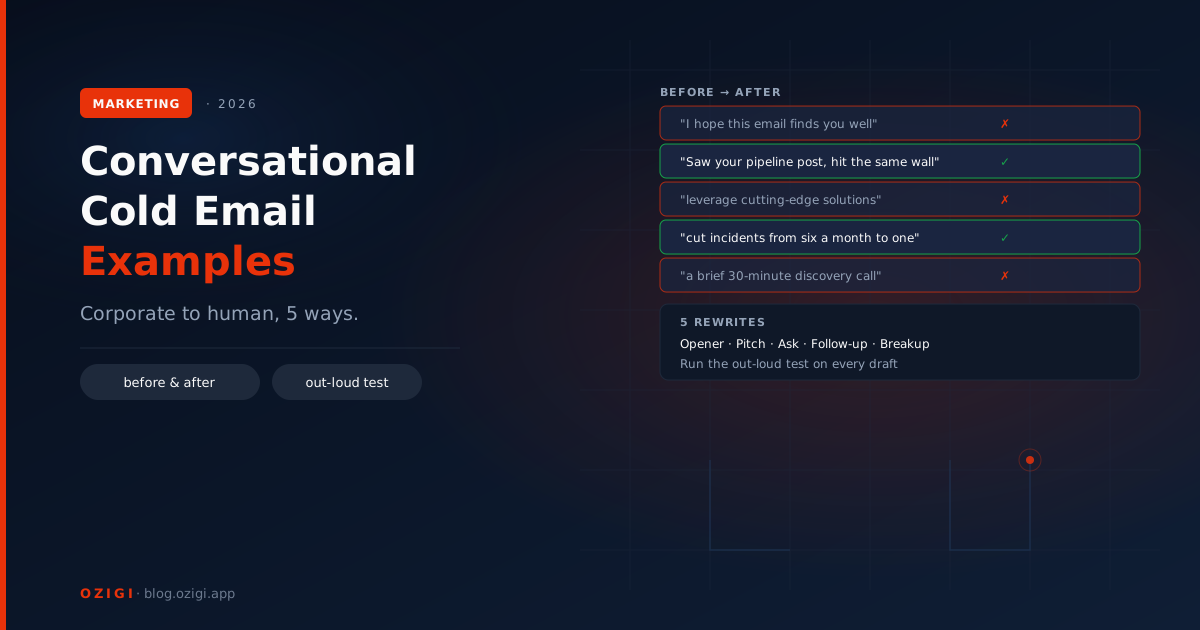
TL;DR: Conversational cold emails get replies because they read like one person writing to another, and the fastest way to learn the difference is to see the same email both ways. Below are five before-and-after rewrites covering the opener, the pitch, the ask, the follow-up, and the breakup. The pattern across all five: shorter sentences, contractions, no corporate vocabulary, one specific detail about the recipient, and an ask a human would actually say out loud.
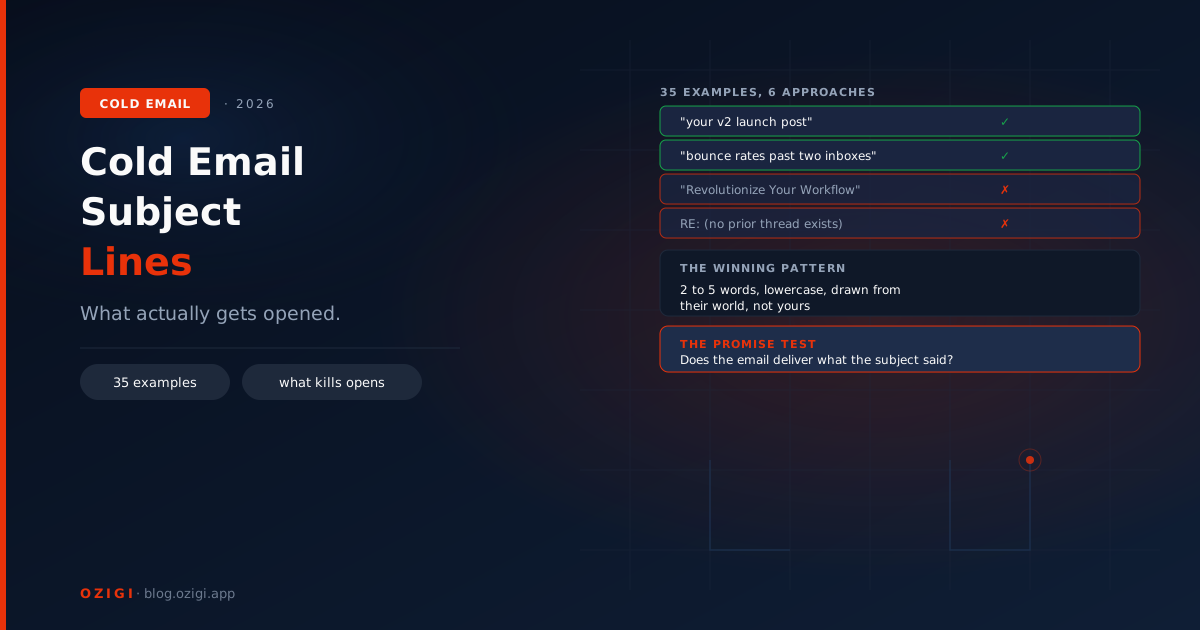
Read your last cold email out loud. If you would never say those sentences to a stranger at a meetup, you have found the problem. Nobody says "I hope this email finds you well." Nobody says "I wanted to reach out regarding." Written-only phrases signal pitch, and pitch triggers delete.
Conversational does not mean sloppy, and it does not mean fake-casual with three emojis. It means the email passes the out-loud test. Here are five emails that fail it, rewritten to pass, with the specific changes named so you can run the same edits on your own drafts.
Example 1: The Opener
Before:
Dear Ms. Adeyemi, I hope this email finds you well. My name is Tunde and I am reaching out on behalf of Acme Analytics, a leading provider of data infrastructure solutions for growing organizations.
After:
Hi Amara, saw your post about your pipeline falling over every time the team ships a new event type. We built Acme because the same thing kept happening to us.
What changed: the greeting dropped a title nobody uses in email, the throat-clearing disappeared, and the first sentence became about her instead of the sender. "Leading provider of solutions" is vocabulary no human speaks; "your pipeline falling over" is her own problem in close to her own words. The opener's only job is proving a person looked, and the before version proves the opposite.
Example 2: The Pitch
Before:
Our platform leverages cutting-edge technology to streamline your workflows, boost productivity, and drive measurable ROI across your organization.
After:
Acme catches schema changes before they break your dashboards. Datafold's team cut their pipeline incidents from about six a month to one.
What changed: every abstract claim became one concrete mechanism and one number. The before version could describe ten thousand products, which is exactly why the brain skips it. Conversational pitching is mostly deletion: cut the adjectives, keep the noun, the verb, and the number. If the sentence survives without "cutting-edge," "streamline," and "ROI," it was never carrying them anyway.
Example 3: The Ask
Before:
I would love to schedule a brief 30-minute discovery call at your earliest convenience to explore potential synergies between our organizations.
After:
Worth 15 minutes on Thursday or Friday? If it's not relevant, a one-word no is genuinely fine.
What changed: the ask shrank, got concrete, and offered an easy exit. "Discovery call" and "synergies" are seller words; the recipient hears them as "an hour of my life pitching me." Two named days lower the decision cost, and permission to say no raises replies from both directions, because it reads as confidence rather than desperation. Nobody confident writes "at your earliest convenience."
Example 4: The Follow-Up
Before:
I am just following up on my previous email to circle back and see if you had a chance to review my message. I would hate for this opportunity to slip through the cracks.
After:
One thing I forgot: the Datafold rollout took two days, not the quarter-long migration you would expect. Same offer as before, 15 minutes whenever suits.
What changed: the follow-up stopped narrating itself and added something. "Just following up" and "circle back" announce that this email exists to pressure you, which is why the sequence guide treats every follow-up as a new-information slot, proof, a resource, an idea, never a bump. The full four-email arc with spacing is in the B2B lead generation sequence guide.
Example 5: The Breakup
Before:
As I have not received a response to my previous correspondence, this will be my final attempt to connect. Should your priorities change, please do not hesitate to reach out at your convenience.
After:
Closing this out, seems like the timing's off or I read the problem wrong. Either way, no hard feelings. If pipelines start acting up again, you know where I am.
What changed: the passive-aggressive formality became an honest exit. "As I have not received a response" scolds; "seems like the timing's off" respects. Breakup emails earn some of the highest reply rates in a sequence, but only when they sound like a person genuinely letting go, not a form letter logging its final attempt.
What Makes an Email Conversational? The Checklist
The five rewrites run on the same seven edits:
| Edit | Cut | Keep |
|---|---|---|
| Greeting | Dear + honorific | Hi + first name |
| Opener | I hope this finds you well | A detail about them |
| Vocabulary | leverage, streamline, solutions, synergies | The words they use for their own problem |
| Sentences | 25-word compounds | Under 15 words, contractions on |
| Proof | "measurable results" | One number |
| Ask | 30-minute discovery call | 15 minutes, two named days, easy no |
| Sign-off | Please do not hesitate | Just your name |
Run the out-loud test after the edits. Anything you stumble on when speaking, a reader stumbles on when scanning, and scanning is all a cold email gets.
The catch with conversational tone at volume: it is hard to fake and slow to handcraft. Most AI writing tools make it worse, because generated email defaults to exactly the corporate vocabulary in the before columns. This is the specific problem the free cold email generator is built around: the corporate lexicon and the AI filler are blocked at generation, so the draft starts on the after side of the table, in your voice, and you spend your minute adding the one detail only you know. No signup, so you can pressure-test it against your current draft right now.
Frequently Asked Questions
Do conversational cold emails actually get more replies? Yes, consistently. They read as person-to-person rather than campaign-to-list, which lowers the delete instinct, and their shorter sentences survive the phone preview where most cold email gets its three seconds. The out-loud test is the fastest quality check: if you would not say it, do not send it.
Can a cold email be too casual? Yes. Slang, emoji stacks, and forced jokes fake familiarity you have not earned, and reads worse than formality. Conversational means natural, not chummy: plain words, real sentences, and respect for the fact that this person never asked to hear from you.
Which words should I remove from cold emails? The reliable offenders: "I hope this finds you well," "reaching out," "circle back," "just following up," "touch base," "leverage," "streamline," "solutions," "synergies," "at your earliest convenience," and "please do not hesitate." Each one is written-only vocabulary that signals pitch before your actual point lands.
Does conversational tone work for enterprise buyers? It works better, because enterprise inboxes see the most corporate boilerplate and a plain human sentence stands out most there. Adjust formality one notch, drop the contractions if it suits the industry, but keep the structure: their detail first, one number, small ask.
How do I write conversational emails at scale? Separate the voice from the detail. The structure and tone can be systematized, the per-recipient sentence cannot. Draft with a tool that will not inject corporate filler, the free cold email generator exists for exactly this, then add the one sentence that proves you looked, and keep total volume inside safe daily limits.
Ozigi drafts cold emails that pass the out-loud test, with the corporate vocabulary blocked at generation. Try the free cold email generator, no signup required.
About the author
Founder and CEO of Ozigi. Writes about go-to-market, content strategy, and the tooling small teams rely on.