Marketing Strategies for Technology Companies That Don't Have Marketers (2026)

Founder and CEO of Ozigi. Writes about go-to-market, content strategy, and the tooling small teams rely on.
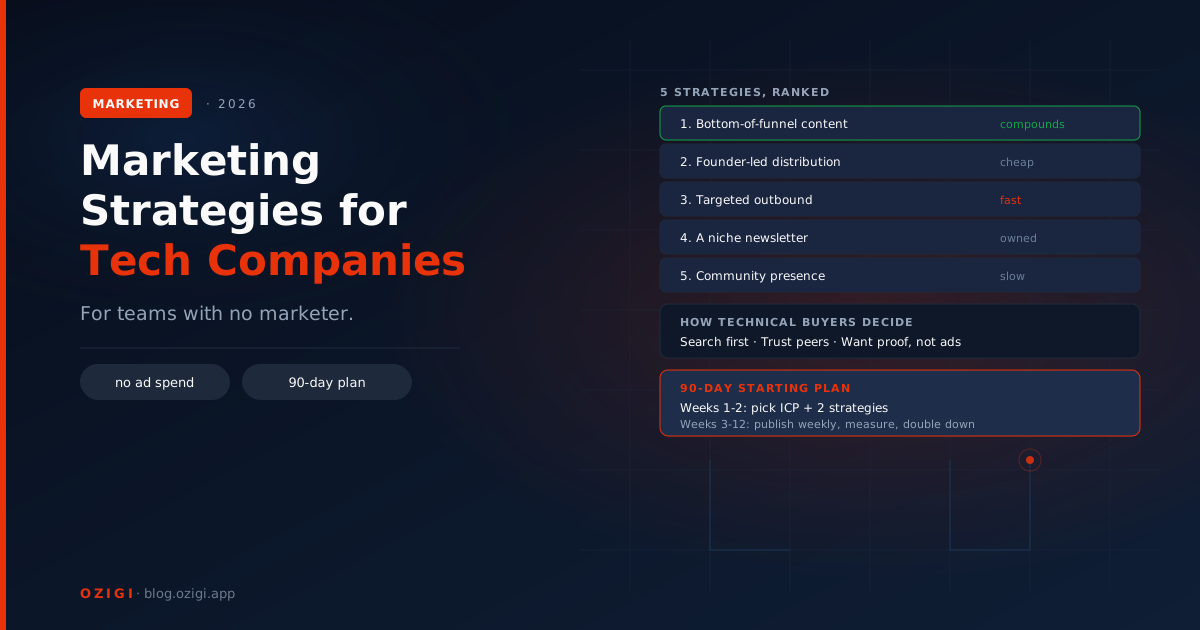
TL;DR: Technical buyers decide through search, peers, and proof, so the strategies that work for technology companies are the ones that show up in those three places: bottom-of-funnel content, founder-led distribution, targeted outbound, a niche newsletter, and community presence. Ads mostly burn money before product-market fit. Pick two strategies you can run weekly, hold them for two quarters, and measure signups, not impressions. A 90-day starting plan is at the end.
Most marketing advice for technology companies is written by marketers, for marketers. It assumes a team, a budget, and a brand department. Most tech companies under 20 people have none of those. They have engineers, a product, and whoever drew the short straw this quarter.
The good news: technical buyers make the playbook simpler, not harder. They search before they buy, they trust peers over ads, and they want proof over promises. Every strategy below exists to put you in one of those three places.
Why Do Normal Marketing Playbooks Fail for Tech Companies?
Because the standard playbook is built on interruption, and technical buyers have trained themselves to ignore interruption. Developers run ad blockers. Engineering managers do not click display ads. CTOs do not download gated whitepapers to sit through a sales cadence.
What technical buyers do instead is predictable: they search their exact problem, they ask peers in communities and group chats, and they evaluate proof, docs, benchmarks, a working free tier, before ever talking to sales. Marketing that meets them there works. Marketing that interrupts them mostly measures its own impressions.
Strategy 1: Bottom-of-Funnel Content
The highest-return strategy for a technical product is content that answers the questions buyers type in the week before they purchase: comparisons, "how to fix X," and use-case guides. It compounds, it costs time instead of cash, and it doubles as sales collateral.
The trap to avoid is starting at the top of the funnel with definitional posts that draw readers who will never buy. The full publishing order, what to write first and why, is the core of the content marketing for startups playbook. One addition specific to tech audiences: technical buyers increasingly get answers from AI search, so structure posts to be quotable there, direct answers first, question headings, real numbers. That discipline is covered in the GEO and AEO guide.
Strategy 2: Founder-Led Distribution
For a technology company under 20 people, the founder's voice outperforms the company's voice everywhere it shows up. People follow people. A founder posting real build decisions, real numbers, and real opinions on the platforms their buyers read earns trust no brand account can, because a brand account has an obvious agenda and a founder has a story.
The sustainable version is repurposing, not creating: each blog post becomes a thread, a LinkedIn post, and a newsletter section, roughly 45 minutes of distribution per piece. The mechanics, including how to do this without becoming a full-time poster, are in marketing for technical founders.
Strategy 3: Targeted Outbound
Content compounds slowly; outbound produces conversations this month. The two run in parallel: outbound funds the patience that content requires. For technical products the targeting signals are unusually good, public repos, job postings, stack pages, and posts reveal exactly who has the problem you solve, which is why small-list, high-relevance outbound beats volume blasting for this audience specifically.
The complete motion for a small team, list building through sequencing, is in outbound for bootstrapped startups. The one rule that matters most: every email must contain a sentence true only for that recipient. Technical buyers delete pattern-matched mail faster than anyone.
Strategy 4: A Niche Newsletter
A newsletter is the only channel a technology company owns outright. Search rankings and social reach are rented from algorithms; a subscriber list is yours. For a tech company the winning format is narrow and useful: one problem space, real lessons from building, no company-news filler. Five hundred subscribers who all match your buyer profile beat fifty thousand who do not.
It also closes the loop on the other strategies: blog readers and outbound replies who are not ready to buy have somewhere to land that keeps them close until they are. Setup, cadence, and growth for a small team are covered in how to start a newsletter in 2026.
Strategy 5: Community Presence Without Community Spam
Being genuinely useful in the places your buyers already gather, specific subreddits, Discords, Slack groups, forums, builds the peer trust that technical buying runs on. The rule is a 10-to-1 ratio: ten contributions that have nothing to do with your product for every one mention of it, and mentions only when someone's question is literally what you solve.
This strategy is slow, unmeasurable, and real. It is also the one most commonly faked, and communities are ruthless with fakers. If you cannot commit to actually participating, skip it entirely; a drive-by self-promotion habit costs more reputation than absence does.
Which Strategy Should You Start With?
Two of them, chosen by your constraint. Every company under 20 people should run Strategy 1 in some form, because search is where technical buying starts. Pair it based on what you need most:
| Your situation | Run content plus | Why |
|---|---|---|
| Need pipeline this quarter | Outbound | Conversations in weeks, not months |
| Have some inbound, weak retention of interest | Newsletter | Catches the not-yet-ready |
| Founder has opinions and some following | Founder-led distribution | Cheapest reach multiplier |
| Product spreads peer to peer | Community | Matches the buying motion |
The 90-day starting plan: weeks 1 to 2, write your ICP and pick the two strategies. Weeks 3 to 12, publish one bottom-of-funnel piece per week and run your paired strategy on a fixed weekly block. Measure three numbers monthly: signups by source, replies or subscribers depending on the pair, and rankings on ten buying-intent keywords. At day 90, double what moved and cut what did not.
Frequently Asked Questions
What is the best marketing strategy for a technology company? Bottom-of-funnel content paired with one distribution or pipeline strategy, founder-led posting, targeted outbound, or a newsletter, chosen by your biggest constraint. Technical buyers decide through search, peers, and proof, and these are the strategies that show up in those places.
Should tech startups spend on paid ads? Usually not before product-market fit. Technical audiences block, ignore, or distrust ads, so early spend mostly buys impressions from non-buyers. The exception is small search spend on high-intent, bottom-of-funnel queries where you already know the page converts.
How much should a technology company spend on marketing? Pre-revenue, spend hours instead of dollars: 5 to 10 founder hours a week on two strategies. Post-revenue, common practice lands between 10 and 20% of revenue, but for technical products the constraint is usually founder input and consistency, not budget.
How long until these strategies show results? Outbound produces conversations in 2 to 4 weeks. Founder-led posting builds in 1 to 3 months. Content and newsletters need 4 to 8 months to compound. Run one fast strategy and one compounding strategy in parallel so the slow one gets the runway it needs.
Ozigi runs the content and outbound halves of this playbook from one place: sourced leads, sequenced emails, and long-form content in your voice with the AI filler blocked. Try the free long-form generator, no signup required.
About the author
Founder and CEO of Ozigi. Writes about go-to-market, content strategy, and the tooling small teams rely on.