Content Marketing for Startups: A Playbook for Teams of One (2026)

Founder and CEO of Ozigi. Writes about go-to-market, content strategy, and the tooling small teams rely on.
TL;DR: Content marketing works for startups when you treat it as a compounding asset, not a launch tactic. Pick one channel and one format you can sustain weekly. Publish bottom-of-funnel content first: comparison pages, problem posts, and use cases that a buyer reads the week before they purchase. Budget realistically: doing it yourself costs time, a freelancer runs $500 to $2,000 a month, an agency starts around $5,000. Do not hire an agency before you have proof that content converts. Expect meaningful traffic in 4 to 8 months, and measure signups from content, not pageviews.
Most startup content marketing advice is written for companies with a content team. You do not have a content team. You have a product to build, maybe a cofounder, and a few hours a week that marketing has to fit inside.
This playbook is for that situation. It covers what to publish, in what order, what it costs, when to bring in outside help, and how to tell whether any of it is working. Every recommendation here assumes one person is doing the work.
Does Content Marketing Actually Work for Startups?
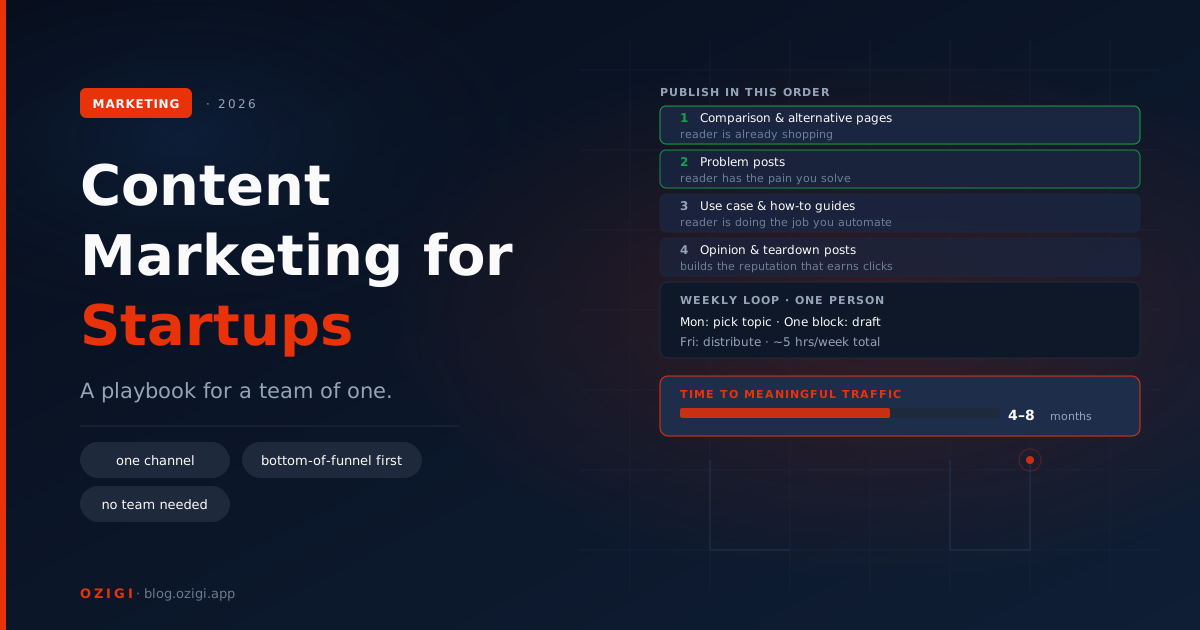
Yes, with one condition: you have to run it long enough to compound. A blog post that ranks keeps sending you buyers for years at zero marginal cost. An ad stops the moment you stop paying. That difference is the entire case for content, and it is also why most startups quit too early. The typical pattern is five posts in six weeks, no traffic, abandonment. Rankings take 4 to 8 months to build on a new domain. Quitting at month two means paying the cost and skipping the payout.
Content also does work ads cannot. It answers the questions your buyer asks before they know your product exists, which means you reach them before your competitors' retargeting does. And every piece doubles as sales collateral: the comparison page you wrote for search is the same link you send a prospect who asks how you differ from the incumbent.
The condition matters, though. If you need pipeline in the next 30 days, content will not deliver it. Run outbound for near-term pipeline and content for the compounding layer, in parallel. The outbound side of that motion is covered in outbound for bootstrapped startups.
What Should a Startup Content Strategy Look Like?
One channel, one format, one audience, held for at least six months. That is the whole strategy. Startups fail at content by spreading across a blog, a podcast, three social platforms, and a newsletter, then producing nothing consistently anywhere.
The selection logic is simple. Pick the channel where your buyers already look for answers. Selling to developers usually means SEO-focused blog posts and a presence on the platforms where developers read, because developers search before they buy and distrust ads. Selling to consumers might mean short video instead. Choose based on where the buyer is, not where you enjoy posting.
Then define the job of each piece before you write it. Every post should target either a search query your buyer types or a question your prospects ask on sales calls. If a piece does neither, it is a hobby, not marketing. This discipline is what separates a content strategy from a publishing habit, and it is the core of the broader playbook in marketing for technical founders.
What Content Should a Startup Create First?
Start at the bottom of the funnel and work up. Bottom-of-funnel content converts at the highest rate and faces the least competition, because big publishers chase volume and ignore the queries typed by people a week away from buying.
The publishing order that works:
| Priority | Content type | Example query it captures | Why first |
|---|---|---|---|
| 1 | Comparison and alternative pages | "your product vs incumbent", "incumbent alternatives" | Reader is already shopping |
| 2 | Problem posts | "why am I getting no replies to my cold emails" | Reader has the pain your product solves |
| 3 | Use case and how-to guides | "how to warm up a sending domain" | Reader is doing the job your product automates |
| 4 | Opinion and teardown posts | takes on your industry, breakdowns of what works | Builds the reputation that makes people click your name |
Ten strong bottom-of-funnel pieces beat fifty generic top-of-funnel posts. "What is content marketing" has a million competitors and readers who will never buy from you. A post like our own best free GTM tool comparison has a handful of competitors and readers holding a credit card. Write that kind until you run out of buyer questions, and only then move up the funnel.
One addition for 2026: buyers increasingly get answers from AI search rather than ten blue links. Structuring content so it gets cited there is its own discipline, covered in the GEO and AEO guide. The short version: direct answers near the top of each section, question-form headings, and specific numbers that an answer engine can quote.
How Much Does Content Marketing Cost a Startup?
Between zero dollars and $5,000 a month, depending on whose hours you spend. The real question is which resource you have more of: time or cash.
| Approach | Monthly cost | What you get | Right for |
|---|---|---|---|
| Founder-written | $0 plus 4 to 8 hours a week | 2 to 4 pieces with real expertise in them | Pre-revenue, technical products |
| Founder plus AI tooling | $0 to $50 | Same output in half the hours | Any stage, if quality is policed |
| Freelance writer | $500 to $2,000 | 2 to 4 pieces, quality varies widely | Post-revenue, founder reviews drafts |
| Agency | $5,000 and up | Strategy plus production | After content has proven it converts |
The uncomfortable truth in that table: at the early stage, founder-written content usually outperforms hired content, because the founder knows things a freelancer cannot fake. Specificity is what ranks and what converts, and specificity lives in your head. The hours are the price of extracting it.
When Should a Startup Hire a Content Marketing Agency?
Not before you have evidence that content converts for your business, which usually means not before roughly $1M ARR or a clear pattern of signups arriving from posts you wrote yourself. An agency amplifies a working motion. It cannot find your motion for you, and at $5,000 a month minimum, paying one to experiment is an expensive way to learn what a founder learns free.
Outsource in steps instead. First hire out the mechanical work: editing, formatting, publishing, distribution. Keep the thinking. Then hand off drafting for content types you have already proven, with you reviewing every piece for accuracy and voice. Hand off strategy last, if ever. The startups that get burned by agencies are the ones that handed off strategy first and spent six months paying for generic posts that could have been written about any company in their category.
There is one early exception: a specialist for a single technical job, like a site migration or a schema overhaul. That is a project fee, not a retainer, and it is often worth it.
How Do You Run Content Marketing With No Team?
Run a weekly loop small enough that a bad week cannot break it. The system that works for a team of one:
Monday, 30 minutes: pick the topic. Pull it from a sales call question, a support ticket, or your keyword list. Never start from a blank page. The topic backlog is built from real buyer language, which is also what makes the piece rank.
One block, 2 to 3 hours: produce the draft. Write the parts only you know: the opinion, the numbers, the war story. Use AI tooling for structure and expansion, with two hard rules. First, you feed it real raw material, your notes, your data, your transcript, never a bare prompt, because a bare prompt produces the same post your competitor's bare prompt produces. Second, you strip the AI vocabulary before publishing. Readers now recognize it instantly, and platform algorithms increasingly penalize it. This is the exact problem Ozigi's banned lexicon exists to solve at generation time rather than in editing.
Friday, 45 minutes: distribute. One piece becomes a thread, a LinkedIn post, and a newsletter section. Repurposing is how a solo founder shows up everywhere without writing everything. The newsletter half of that system is covered in how to start a newsletter in 2026.
That is roughly five hours a week for a piece published and distributed. Sustainable beats ambitious. A post every week for a year is 52 assets. A post every day for three weeks is 15 assets and a burned-out founder.
How Do You Measure Content Marketing ROI for a Startup?
Count signups and pipeline that touched content, not pageviews. Traffic is an input. The metrics that decide whether to keep investing:
Signups with content as first touch. Ask "where did you hear about us" at signup and read the answers. Imperfect attribution beats no attribution.
Rankings on money keywords. Track the 10 to 20 queries that indicate buying intent for your product. Movement from position 40 to position 15 predicts revenue months before revenue shows up, which matters because content's lag would otherwise make it look like failure exactly when it is starting to work.
Sales cycle usage. If your prospects mention a post, or your comparison page shows up in deal threads, content is doing revenue work that analytics will never attribute.
Review monthly, decide quarterly. A piece that ranks for a buying-intent query and gets mentioned on sales calls earns more investment in its cluster. A category of posts that draws traffic but zero signups gets cut, regardless of how good the traffic chart looks.
Frequently Asked Questions
How does content marketing benefit my startup? It compounds. A ranking post sends you qualified buyers for years at no marginal cost, reaches people before they see your competitors' ads, and doubles as sales collateral. The tradeoff is time: expect 4 to 8 months before meaningful traffic on a new domain.
When should a startup hire a content marketing agency? After content has proven it converts, usually around $1M ARR or a clear pattern of content-sourced signups. Before that, founder-written content outperforms agency content because it contains knowledge an agency cannot fake. Outsource mechanics first, drafting second, strategy last.
When should a startup outsource content marketing? In steps. Hand off editing, formatting, and publishing as soon as budget allows, around $500 to $2,000 a month for freelance help. Keep topic selection and final review with a founder until the motion is proven, because those two steps are where the quality lives.
How much should a startup budget for content marketing? Founder-led content costs 4 to 8 hours a week and little cash. Freelance support runs $500 to $2,000 a month. Agencies start around $5,000 a month and only make sense once content demonstrably converts. Most startups should start at the top of this list, not the bottom.
How do you measure ROI of content marketing for a startup? Track signups that name content as their source, rankings on 10 to 20 buying-intent keywords, and mentions of your content in sales conversations. Pageviews alone measure nothing a startup can bank. Review monthly, make cut-or-double decisions quarterly.
Is content marketing still relevant for dev-tool startups? More than ever, with a shift: developers now get answers from AI search as well as Google, so content needs direct answers, question-form headings, and quotable specifics to get cited. Developers still distrust ads and still search before buying, which is exactly the behavior content captures.
How long until content marketing shows results? First rankings in 2 to 4 months, meaningful traffic in 4 to 8, and revenue attribution often a quarter after that. The lag is the price of an asset that keeps paying after you stop feeding it, which ads never do.
Ozigi turns your raw notes, docs, and transcripts into articles, posts, and newsletters that sound like you wrote them, because the AI filler is blocked at generation. Try the free long-form article generator, no signup required.
About the author
Founder and CEO of Ozigi. Writes about go-to-market, content strategy, and the tooling small teams rely on.