60+ AI Words to Avoid in Your Writing (The Ozigi Banned Lexicon)

Founder and CEO of Ozigi. Writes about go-to-market, content strategy, and the tooling small teams rely on.
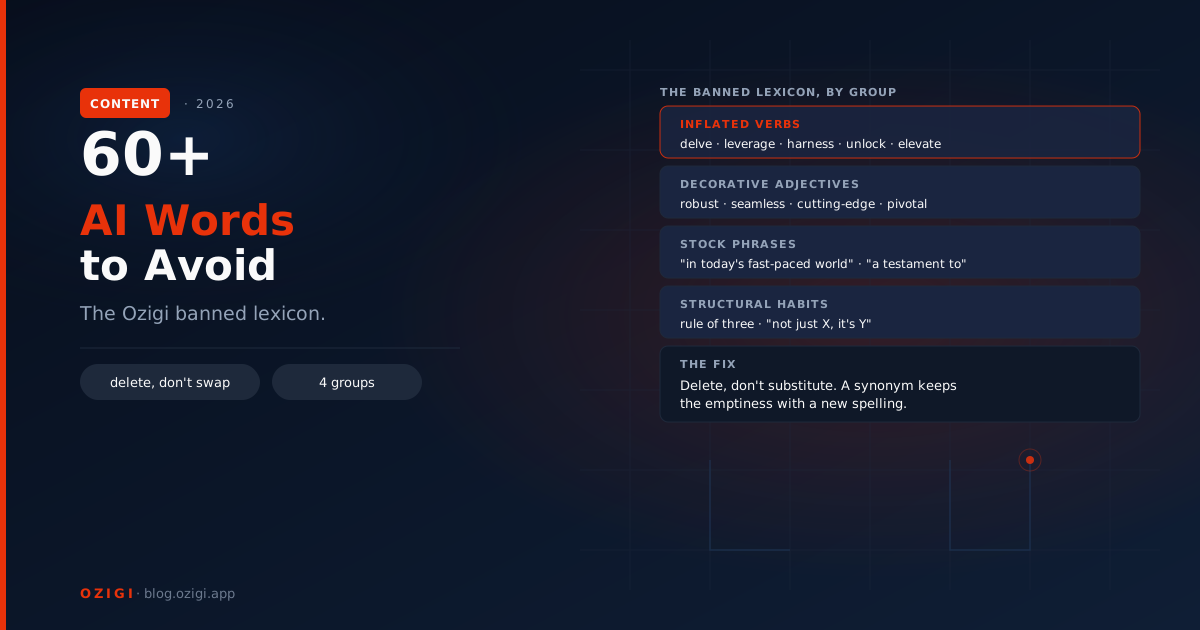
TL;DR: AI writing gets caught by vocabulary before anything else. The tells cluster into four groups: inflated verbs (delve, elevate, unlock, harness, foster), decorative adjectives (robust, seamless, cutting-edge, transformative, pivotal), stock phrases ("in today's fast-paced world," "it's important to note," "a testament to"), and structural habits (rule-of-three everything, "isn't just X, it's Y," essay conclusions on emails). The fix is deletion, not synonym-swapping: most of these words carry no meaning, so replacing them with fancier words keeps the problem. The full list is below. It is part of the lexicon Ozigi blocks at generation, published because a list you have to enforce by hand is a chore, and that chore is our product.
Readers now pattern-match AI text in about two sentences, and they discount it the moment they do. Not because generated text is wrong, but because the vocabulary signals nobody chose these words, and writing nobody chose is writing nobody needs to finish.
We maintain a banned lexicon for exactly this reason, every draft Ozigi generates is checked against it before you see it. Here is a good portion of that list, organized by how each group gives you away, so you can run the same edit manually on anything you write anywhere.
Why Does AI Writing Sound Like AI?
Because models are trained to sound impressive on average, and impressive-on-average is a specific dialect. It inflates verbs, decorates nouns, hedges claims, and pads transitions, the exact opposite of how a busy person with a point writes. A human expert writes "this breaks at scale." The dialect writes "it's worth noting that this approach may present significant challenges in the context of scaling."
The tells below are just that dialect, catalogued. None of these words is wrong in isolation; a human occasionally delves. The signal is density: three or four per paragraph, and every reader's pattern-matcher fires.
Group 1: The Inflated Verbs
The tell: the verb is grander than the action. Nobody leverages a spreadsheet.
| Banned | What a person says |
|---|---|
| delve into | look at, dig into, cover |
| leverage | use |
| utilize | use |
| harness | use |
| unlock | get, enable, or delete the clause |
| elevate | improve |
| foster | build, encourage |
| facilitate | help, run |
| streamline | simplify, speed up |
| empower | let, help |
| supercharge | speed up, or delete |
| revolutionize | change, or state the actual change |
| embark on | start |
| navigate (metaphorical) | handle, deal with |
| spearhead | lead, run |
| bolster | strengthen, support |
| garner | get, earn |
| underscore | show, stress |
The pattern in the right column: the honest verb is shorter. When a draft is full of long verbs doing small jobs, the vocabulary is compensating for a missing point.
Group 2: The Decorative Adjectives
The tell: the adjective could attach to anything, so it means nothing.
| Banned | The fix |
|---|---|
| robust | Delete, or give the number that makes it robust |
| seamless | Delete, or describe the actual absence of steps |
| cutting-edge | Delete |
| innovative | Delete, the innovation should be visible without the label |
| transformative | State what changed |
| pivotal | important, or delete |
| crucial / vital | important, or delete |
| comprehensive | full, complete, or delete |
| dynamic | Delete |
| holistic | Delete, or say what it includes |
| game-changing | State the change |
| state-of-the-art | Delete |
| unparalleled | Delete, it is almost never true |
| meticulous | careful, or show the detail |
| ever-evolving | changing, or delete |
Deletion beats substitution for this whole group. Swapping "robust" for "powerful" trades one empty word for another; cutting it forces the sentence to carry proof instead, a number, a mechanism, a named result. Proof is the thing decorative adjectives were hired to fake.
Group 3: The Stock Phrases
The tell: whole clauses that exist in millions of documents verbatim.
- "In today's fast-paced world" and every "in today's [adjective] landscape" variant
- "It's important to note that," "it's worth mentioning that", if it were not, you would not be mentioning it
- "A testament to"
- "At the end of the day"
- "When it comes to"
- "In the realm of," "in the world of"
- "Look no further"
- "Whether you're a [X] or a [Y]"
- "Dive deep" and "deep dive" as verbs for reading
- "Take it to the next level"
- "The possibilities are endless"
- "In conclusion," "to summarize", in anything shorter than a thesis
- "I hope this email finds you well", the email-shaped member of this family, covered with its relatives in conversational cold email examples
Every phrase here is a transition or a hedge, and the edit is the same: delete it and start the sentence at the content. The paragraph almost always improves, which tells you what the phrase was contributing.
Group 4: The Structural Habits
Vocabulary is the fastest tell, but structure is the deepest one, and structure survives synonym-swapping.
The rule of three, everywhere. Generated text triples compulsively: "faster, cheaper, and more reliable," in every sentence, every list, every heading. Humans vary: sometimes one reason, sometimes four, sometimes a triple because the content genuinely comes in threes.
"It's not just X, it's Y." The signature construction of the dialect. Once per document is a device; four times is a fingerprint.
The essay conclusion on everything. A 200-word email does not need a paragraph that restates the email. Generated text closes every unit like a five-paragraph essay because it was trained on five-paragraph essays.
Uniform paragraph length. Three sentences, three sentences, three sentences. Human paragraphs breathe: a long one, then a two-word one. Like that.
Hedged everything. "May potentially help to somewhat improve", stacked qualifiers that protect the writer from every claim. Pick the claim you can defend and make it plainly.
How Do You Fix AI-Sounding Writing?
Three passes, in order. First, delete: every Group 2 adjective and Group 3 phrase comes out, no replacement, and the text immediately tightens. Second, downgrade the verbs: every Group 1 verb becomes its short honest version. Third, break the structures: vary the paragraph lengths, cut the triples down to the ones that earn it, and end when the point ends rather than when the essay shape says to.
Then add the thing no list can generate: one sentence only you could write, your number, your example, your opinion. Vocabulary edits make text inoffensive; specificity makes it worth reading, which is the actual bar, for readers and increasingly for search and answer engines deciding what to cite.
The honest limitation of everything above: it is an editing tax, paid on every draft, forever, and the tax is why most people who know better still ship "robust seamless solutions." That tax is the reason Ozigi exists. The lexicon on this page is enforced at generation, not in your editing pass, so the free long-form generator hands you a draft that already went through all three passes, in your voice, with your raw material as the specificity. No signup, so the fastest way to test the claim is to give it a topic and count the banned words in what comes back.
Frequently Asked Questions
What words make writing sound like AI? The dense co-occurrence of inflated verbs (delve, leverage, harness, elevate), decorative adjectives (robust, seamless, cutting-edge, transformative), and stock phrases ("in today's fast-paced world," "it's important to note"). Any one word is innocent; three per paragraph is the fingerprint.
Should I replace AI words with synonyms? No, delete them. Most carry no meaning, so a synonym keeps the emptiness with a new spelling. Cutting "robust" forces the sentence to hold a number or a mechanism instead, and the proof is what the adjective was standing in for.
Do AI detectors check for these words? Vocabulary is one signal detectors and readers share, but structure runs deeper: uniform paragraphs, compulsive triples, "not just X, it's Y," and essay conclusions on everything. Human readers are the detector that matters commercially, and they fire on both.
Can AI writing tools avoid these words? Only if the ban is enforced at generation rather than requested in a prompt. Asking a model to "avoid AI words" reduces them; blocking the lexicon in the generation layer removes them. The second approach is how Ozigi works, which is why this list can be public.
Is it bad to use words like "delve" and "robust" at all? No single use is a problem, humans wrote these words for decades. The tell is density and pairing: "delve" next to "seamless" next to "in today's landscape" in one paragraph. Sparse, chosen use reads fine; ambient use reads generated.
The list above is part of the lexicon Ozigi enforces on every draft it generates. Try the free long-form generator, no signup required, and count the banned words in what comes back.
About the author
Founder and CEO of Ozigi. Writes about go-to-market, content strategy, and the tooling small teams rely on.